It takes a few seconds to register before you enter this architectural icon, because even from the outside, the effect is striking, and something in your brain hesitates before it can process what your eyes are doing: looking up. Always up. The towers pull you there whether you want to go or not.
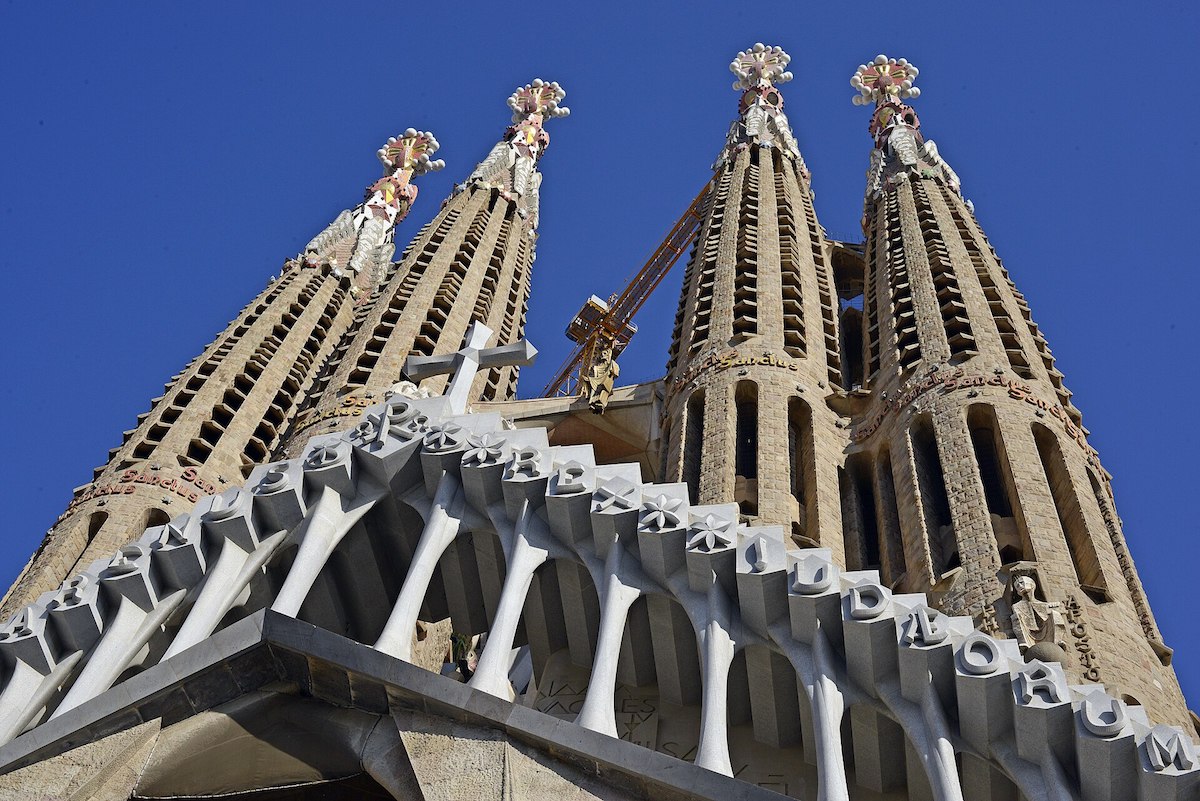
After 144 years, the cathedral is finally finished. The Sagrada Família, Gaudí’s inconceivable church in the middle of Barcelona, reached its full height earlier this year when the last major structural element (the tallest tower) was completed: a cross, placed atop the Tower of Jesus Christ in February, bringing the total height to 566 feet—the tallest church on the planet.
Pope Leo XIV, the eleventh pope to have reigned since the whole project began, will lead a Solemn Mass on Wednesday and formally inaugurate the final tower. A ceremonial blessing. One hundred years to the day from Gaudí’s untimely death (a trolley hit him), which is either a remarkable coincidence or very careful scheduling. Probably the latter.
The cross itself is not a small object. Roughly the height of a five-storey building, somewhere around 100 tons, fabricated in Germany and shipped to Spain in 14 sections, then lifted by crane to a workshop sitting 200 feet in the air directly over the central nave. Workers up there finished the pieces by hand, with stone interiors, enamelled white ceramic cladding, and windows made from locally sourced glass. It reflects sunlight during the day. At night it’s lit up. Gaudí had wanted exactly that, apparently, which is either a sign of his total vision or the kind of detail that gets added to the mythology after the fact.
The architect in charge of the cross, Mauricio Cortés, is Mexican and talks about the project with the measured calm of someone who has spent years negotiating between a dead genius and a functioning building code. The stainless steel is not something Gaudí would have used — the material barely existed in usable form during his lifetime — but it kept the structure light enough, actually, to work. “The times have changed,” Cortés said, walking through the basilica. “The technology has evolved, as have the regulations.” He seemed unbothered by the compromises. Most people working on the project seem to have arrived at a kind of peace with them.
What’s worth saying is that this is genuinely not a simple building to look at. The geometry is uncomfortable in the best sense. Gaudí’s reverence for natural forms, the way a bone curves, the way a tree distributes weight, runs through every surface, and standing inside is less like standing in a cathedral and more like standing inside something alive. The roof of the central nave breaks into colour. Ceramics on the gables, Venetian glass on the pinnacles, the bell towers on both the Nativity and Passion facades reading as dense, dense visual narratives in carved stone.
The beatification question is hovering over this week’s visit. Gaudí was declared Venerable last year, and it’s suspected — widely, in the Barcelona press at least — that Leo XIV may announce his beatification during the ceremonies. One step from sainthood. Peter Stanford, who wrote the biography Gaudí: God’s Architect and spent three months working with the beatification committee, describes an abundance of claimed miracles, hips and otherwise, and a Vatican that has apparently signed off on at least one of them as inexplicable. “The Pope could declare him blessed by the church’s own rules,” Stanford said, “or the Pope also has the power to chuck the rules out the window and just call him a saint.” That’s not a sentence you often hear about an architect.
The original plans for the church were largely destroyed in the 1930s. Everything built since has required a kind of forensic interpretation, a reading of fragments, drawings, and models, made increasingly precise by computer-controlled stone-cutting and the accumulated expertise of the people who’ve spent their working lives on the undertaking. There’s a whole tradition of it now. An institutional memory that serves as a substitute for documents that no longer exist.
Wars. Funding gaps. Politics. The delays were never really mysterious. A project this size, in a city that went through what Barcelona went through, was always going to have an uneven history. What’s incredible is that it got finished at all. Or close enough to have the Pope come and say Mass.
Photo: Barcelona’s Sagrada Família, by Alberto-g-rovi